


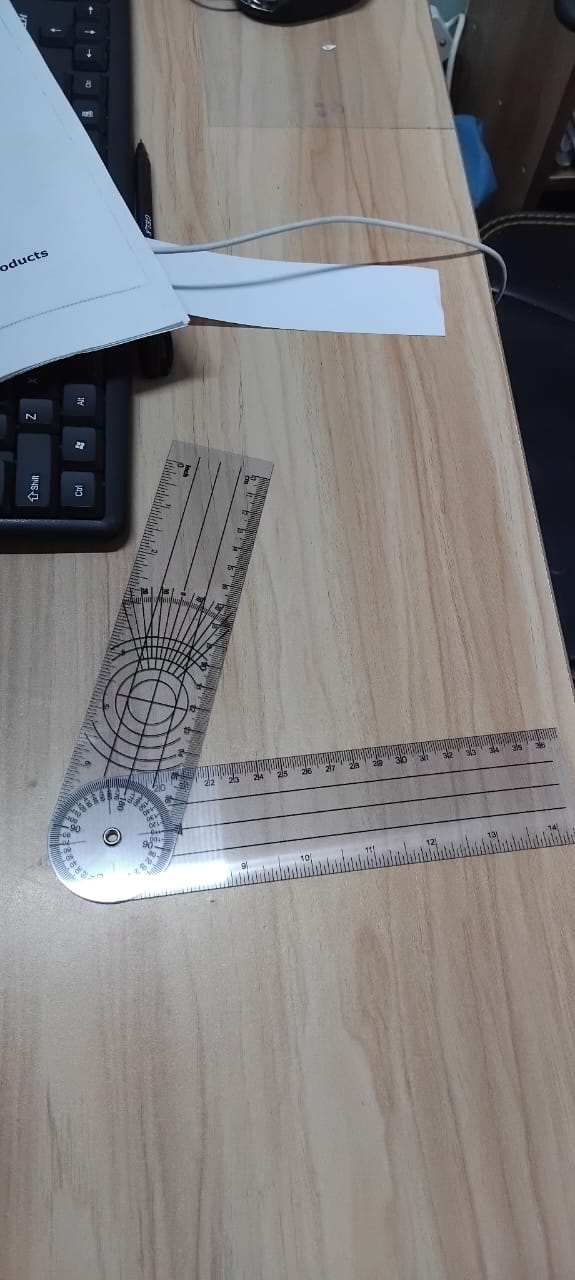
Goniometer1
KSh1,000.00
Goniometer1
Achieve unparalleled precision in every angle measurement with the Goniometer1, offering professional-grade accuracy at the accessible price of KSh1,000.00. This essential tool ensures reliable results for clinical, engineering, or research applications, making it a cost-effective solution for demanding environments. Discover how its robust design and ease of use can transform your workflow today.
Add to cart
Buy Now

For clinicians, athletes, and ergonomics specialists, precision in measuring joint range of motion is not a luxury—it is the absolute foundation of effective assessment, treatment planning, and progress tracking. Inaccurate or inconsistent measurements can lead to misdiagnosis, ineffective rehabilitation protocols, and an inability to objectively demonstrate patient improvement. The Goniometer1 directly addresses this critical need by providing a durable, no-frills tool that delivers laboratory-grade accuracy in a clinical or field setting, ensuring your data is trustworthy from the first measurement to the last. It transforms a simple mechanical tool into an indispensable component of evidence-based practice.
The core challenge in joint measurement is consistency. Flimsy plastic goniometers can warp under slight pressure, their printed scales fade, and their arms slip during use, introducing significant user error. The Goniometer1 eliminates these variables through its robust, professional-grade construction. Its entire body, including the stationary arm, protractor head, and movable arm, is machined from a single piece of high-grade stainless steel. This is not merely a coating; it is a solid material choice that guarantees the tool will never bend, crack, or lose its calibrated shape, even after years of daily use in demanding environments. For you, this means a one-time investment in a tool that will not require replacement due to wear, providing unwavering reliability session after session.
The value of this construction is realized in the measurement experience. The stainless steel arms feature a matte, non-glare finish with deeply etched, laser-engraved degree markings. Unlike printed scales that wear off, these markings are permanent. The scale is clearly graduated in single-degree increments (1°) from 0° to 180°, with bold numerals at every 10° interval. This clarity allows for rapid, confident readings without squinting or second-guessing, even in less-than-ideal lighting. The movable arm locks securely with a smooth, positive-action thumb screw, holding its position firmly during reading or while transferring the angle to a patient’s chart. This secure lock prevents the arm from drifting, a common source of error with cheaper models, ensuring the number you record is the exact angle measured.
Practical design details further enhance its utility. The protractor head incorporates a precise bubble level. This small feature is transformative for accuracy; it allows you to quickly and reliably align the stationary arm with the anatomical reference line (e.g., the midline of the femur for knee measurements), eliminating guesswork and ensuring every measurement starts from a consistent, true baseline. The overall length of the Goniometer1 is 30 centimeters, with arms that are 25 cm and 12 cm respectively. This size is the industry standard, offering sufficient reach for large joints like the hip and shoulder while remaining compact enough for smaller joints like the wrist and ankle. Its weight of 120 grams provides a solid, premium feel without causing hand fatigue during prolonged use.
The practical applications are vast and critical. In physical therapy, it is used to quantify initial limitations in knee flexion post-ACL reconstruction, track improvements in ankle dorsiflexion for a patient with plantar fasciitis, or measure external rotation of the shoulder in a rotator cuff case. In sports medicine, it objectively documents elbow extension loss in a baseball pitcher or hip internal rotation in a soccer player, guiding return-to-play decisions. For occupational health and ergonomics, it assesses workstation suitability by measuring wrist extension during typing or shoulder abduction during repetitive reaching tasks. Its simplicity and accuracy make it equally valuable for research, student training, and home exercise programs prescribed by a therapist, where patient self-measurement must still be valid.
Consider the total cost of ownership. While the initial price point of KSh1,000.00 may compare favorably to more complex digital alternatives, the true economic advantage lies in its durability and zero maintenance. There are no batteries to replace, no calibrations to perform, no software to update, and no fragile electronic components that can fail. It is a tool for a lifetime of practice. When you factor in the cost of replacing multiple cheaper, imprecise goniometers over a few years, the Goniometer1 emerges not just as a purchase, but as a fiscally prudent asset. It delivers professional-grade precision without the professional-grade price tag of digital systems, making accurate measurement accessible to any practice or individual.
Ultimately, the Goniometer1 is more than a measurement device; it is a commitment to clinical excellence. It empowers you to move beyond subjective estimates of “a little better” to definitive, data-driven statements of “improved from 85° to 110° of knee flexion.” This specificity strengthens patient communication, justifies treatment plans to insurers, and provides the undeniable evidence of progress that motivates patients. In a field where precision equals credibility, this tool is your steadfast partner. Choose the Goniometer1 for uncompromising accuracy, enduring construction, and the professional confidence that comes from knowing your foundational measurements are always correct.


